
Emergency Roof Repair in Melbourne, FL
24/7 Emergency Emergency Roof Repair Available in Melbourne, FL
Need emergency roof repair in Melbourne, FL? Melbourne Roofing Experts responds fast 24/7 across Brevard County. Call (321) 415-5164 for immediate storm damage help.
- Licensed & Insured
- Locally Owned & Operated
- Free Inspection & Estimate
Request Your
Free EstimateWhen a storm tears through Brevard County and leaves your roof compromised, every minute matters. Emergency roof repair is the immediate professional response to sudden, severe roof damage — whether caused by hurricane-force winds, falling debris, or rapid structural failure — that prevents further water intrusion, mold growth, and structural harm to your home or business.
Melbourne, FL sits squarely in Florida’s hurricane alley, facing unique threats from Atlantic tropical systems, sudden squall lines off the Indian River Lagoon, and the intense summer thunderstorms that batter the Space Coast year after year. These conditions demand a roofing partner who understands local construction standards, local weather patterns, and Brevard County permitting requirements inside and out.
Melbourne Roofing Experts is that partner. Our crews are stationed locally, ready to respond fast when disaster strikes — providing temporary weatherproofing, damage assessment, and permanent repairs that meet Florida Building Code standards and protect your investment for years to come. Call us now at (321) 415-5164 for immediate assistance.
Understanding Emergency Roof Repair
Emergency roof repair refers to any urgent, unscheduled roofing intervention required to stop active damage, prevent imminent structural failure, or make a home or building safe and weather-tight after an unexpected event. Unlike routine maintenance or planned roof replacement, emergency repair is driven by an immediate threat — a sudden breach that cannot wait days or weeks for a standard appointment.
Historically, Florida’s roofing standards evolved dramatically after Hurricane Andrew devastated South Florida in August 1992, killing 65 people and causing over $27 billion in damage. The catastrophic roof failures exposed major gaps in building codes, leading to sweeping revisions that created the Florida Building Code system we follow today. Here in Brevard County, those lessons are baked into every permit, every inspection, and every shingle installation standard.
Melbourne itself has grown rapidly since the establishment of Patrick Air Force Base (now Patrick Space Force Base) in the 1940s, and the boom of the space industry in the 1960s brought thousands of residential and commercial structures to the area. Many of Melbourne’s older neighborhoods feature homes built in the 1960s through 1980s — decades before post-Andrew code upgrades — making them particularly vulnerable to today’s storm intensities. Neighborhoods like Eau Gallie, downtown Melbourne, and the older sections of West Melbourne contain significant housing stock from these earlier eras.
Modern construction in areas like Viera’s master-planned communities and newer Palm Bay subdivisions tends to be more resilient, but no roof is entirely immune to a direct hit from a strong storm band. Flat commercial roofing common along US-1 and Babcock Street corridors presents its own emergency repair challenges, including ponding water and membrane separation after high winds. Understanding the type of roofing system involved — asphalt shingle, metal, tile, TPO membrane, or modified bitumen — is the essential first step in any emergency response.
Emergency repairs are not just a matter of convenience — Florida statute and standard homeowner’s insurance policies typically require prompt mitigation of damage to avoid claim denial. Quick professional action protects both your home and your financial recovery options.
Why Emergency Roof Repair Is Needed in Melbourne, FL
Atlantic Hurricane and Tropical Storm Exposure
Melbourne sits at approximately 28.1°N latitude, placing it directly in the path of Cape Canaveral’s Atlantic-facing coastline. When tropical systems track up the Florida Straits or the Bahamas Channel, the northern eyewall — statistically the most damaging quadrant — frequently impacts Brevard County communities. Hurricane Frances in September 2004 made landfall near Stuart and delivered sustained winds of 65–75 mph to Melbourne, while Hurricane Jeanne struck just three weeks later on September 25, 2004, following a nearly identical path and producing peak gusts exceeding 100 mph at Melbourne International Airport. Many roofs in Melbourne’s Indialantic and Indian Harbour Beach neighborhoods sustained catastrophic damage in that back-to-back event. Hurricane Matthew in October 2016 tracked just 35 miles offshore and produced sustained winds of 65 mph with gusts to 90 mph, causing widespread shingle loss and structural damage throughout the Eau Gallie area and along the beachside communities of Melbourne Beach and Satellite Beach.
Space Coast Thunderstorm Intensity
Cape Canaveral and the surrounding Space Coast region consistently rank among the most lightning-struck areas in the United States, averaging over 100 thunderstorm days annually. These storms routinely produce wind gusts of 45–60 mph, golf-ball-sized hail, and torrential rainfall rates exceeding 3 inches per hour. The Malabar and Palm Bay areas to the south, as well as the Rockledge corridor to the north, are frequently impacted by rotating thunderstorm cells that develop over the St. Johns River basin and track east toward the coast.
Salt Air and UV Degradation
Properties within 1–2 miles of the Atlantic Ocean, the Indian River Lagoon, or the Banana River — encompassing Melbourne Beach, Indialantic, Satellite Beach, and Cocoa Beach — experience constant salt-laden air that accelerates the oxidation of metal flashing, fasteners, and ridge caps. Combined with Melbourne’s average of 233 sunny days per year and an ultraviolet index that regularly reaches 10–11 during summer months, roofing materials degrade significantly faster than in inland regions. Asphalt shingles that might last 20–25 years in a northern climate may show emergency-level deterioration in 12–15 years along Melbourne’s coastal zones.
Sandy Soil and Foundation Movement
Much of Melbourne and Palm Bay is underlain by Immokalee fine sand and Myakka fine sand — loose, shifting soils that allow for subtle but cumulative foundation movement. Over time, differential settling of 0.5–1.5 inches can create stress fractures in roof decking connections and cause ridge lines to bow, accelerating the likelihood of wind uplift failure during the next significant storm event.
Aging Housing Stock
A substantial percentage of Melbourne’s single-family homes were constructed before 1994 — the year Florida’s strengthened post-Andrew codes went into effect — and lack hurricane straps, reinforced ridge connections, and code-compliant secondary water barriers. When storms strike these older structures, the results often require immediate emergency intervention rather than simple repair.
Signs You Need Emergency Roof Repair
Visible Structural Damage
- Missing shingles, tiles, or metal panels exposing bare decking
- Visibly sagging or bowed roof sections
- Broken or displaced ridge caps
- Fallen tree limbs or debris puncturing the roof surface
- Detached or bent flashing around chimneys, skylights, or vents
Interior Warning Signs
- Active water dripping or streaming into living areas during or after rain
- Water stains on ceilings that expand with each rainfall event
- Wet insulation in the attic — a critical indicator in Melbourne’s humidity
- Visible daylight through roof decking when viewed from inside the attic
- Sudden musty or mildew odor indicating rapid mold onset
Urgency Indicators Specific to Melbourne
- Damage occurring during an active tropical watch or warning period
- Water intrusion in homes with known pre-1994 construction (no secondary water barrier)
- Damage to flat commercial roofs on US-1 or Babcock Street where interior inventory is at risk
- Any breach within two miles of the Indian River Lagoon where humidity is extreme
If you observe any of the above, do not wait. Prolonged exposure to Melbourne’s 90%+ summer humidity can allow mold colonies to begin forming on wet sheathing within 24–48 hours. Call (321) 415-5164 immediately.
Our Emergency Roof Repair Process
Melbourne Roofing Experts follows a structured, proven process designed to protect your property quickly while ensuring every repair meets Florida Building Code and manufacturer specifications.
Immediate Response and Arrival (0–2 Hours)
Upon receiving your call, we dispatch the nearest available crew — typically within 60–90 minutes for addresses in Melbourne, West Melbourne, Palm Bay, and Viera. We confirm your address against current storm tracking data to ensure crew safety during active weather events.
Safety Assessment (30–45 Minutes)
Before any technician accesses your roof, we conduct a ground-level structural safety evaluation. In Brevard County’s post-storm environment, downed power lines, unstable trees, and saturated soil conditions require careful staging of equipment. We use drone imaging when direct access is unsafe.
Emergency Weatherproofing (1–3 Hours)
We immediately install heavy-gauge polyethylene tarps — minimum 6-mil rated — secured with wood battens fastened into rafters rather than simply weighted down. For larger commercial breaches, we deploy self-adhering modified bitumen membrane patches to create a watertight seal capable of withstanding additional rainfall while permanent repairs are planned.
Detailed Damage Documentation (45–60 Minutes)
Our team photographs and videos every area of damage from multiple angles, providing you with a comprehensive damage report formatted to facilitate your insurance claim with Florida-licensed adjusters. We note wind direction, debris sources, and pre-existing conditions honestly and accurately.
Written Repair Estimate (Same Day)
We provide a line-item written estimate on-site or via email within hours, covering temporary weatherproofing already completed, materials required for permanent repair, Brevard County permit fees where applicable, and projected labor timeline.
Permanent Repair Execution (1–5 Days Post-Assessment)
Permanent repairs are scheduled as soon as materials are secured and any required Brevard County permits are issued. We coordinate with your insurance adjuster’s inspection schedule to avoid redundant work. All repairs use Florida Product Approval (NOA) rated materials appropriate for Brevard County’s 130 mph wind design speed.
Final Inspection and Cleanup (Same Day as Repair Completion)
We perform a post-repair inspection, remove all debris and tarping materials, and provide you with a written completion report including product documentation for your insurance file and future reference.
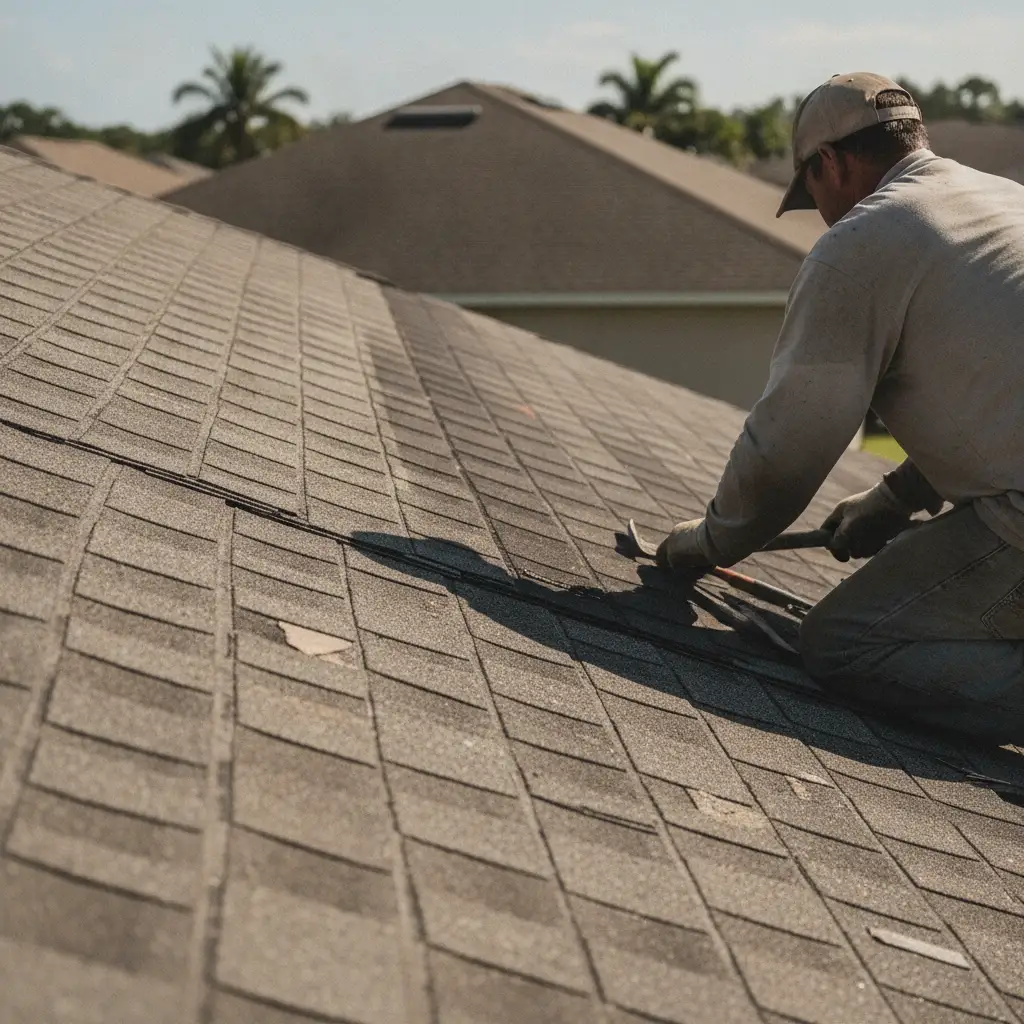
Our team in action — roofing professionals serving Melbourne
Emergency Roof Repair Methods and Approaches
Temporary Tarp Installation
The first line of defense after storm damage, temporary tarping prevents additional water intrusion while permanent materials are sourced. In Melbourne’s frequent post-storm supply chain crunches — common after major hurricanes impact the I-95 corridor — professionally installed tarps can protect a home for weeks. We use FEMA-standard tarping methodology: 6-mil polyethylene, secured with 2×4 wood battens screwed into structural members, not simply draped and weighted.
Shingle Replacement and Partial Re-Roofing
For localized damage covering less than 30% of the roof surface, partial shingle replacement using Florida Product Approval-rated shingles — minimum 130 mph wind rating for Brevard County — is the most common and cost-effective emergency repair method. Color matching to existing shingles is prioritized to maintain curb appeal and property value.
Emergency Flashing Repair
Salt air corrosion and wind uplift frequently compromise aluminum or galvanized flashing around chimneys, skylights, and plumbing vents — particularly in Melbourne Beach, Satellite Beach, and Indialantic properties. We use stainless steel or lead-coated copper flashing in coastal applications to prevent accelerated oxidation.
Membrane Patching for Commercial Flat Roofs
For TPO, EPDM, or modified bitumen commercial roofs along Melbourne’s US-1 and Babcock Street commercial corridors, emergency membrane patching with heat-welded or cold-applied seams provides rapid waterproofing while minimizing business interruption.
Emergency Structural Decking Repair
When wind uplift or impact damage compromises the OSB or plywood roof decking itself — common in pre-1994 Melbourne homes lacking hurricane straps — we perform emergency decking replacement before any surface material is applied, ensuring the repair meets current code standards.
Ready for Emergency Roof Repair? Get Your Free Estimate Today.
Melbourne Roofing Experts serves Melbourne and the surrounding area — we’ll be on-site within 24 hours.
📞 Call (321) 415-5164Emergency Roof Repair Cost in Melbourne, FL
Understanding the cost of emergency roof repair in Melbourne helps you make informed decisions quickly when damage occurs.
Typical Cost Ranges
- Emergency tarping (temporary): $350–$800 depending on roof size and access complexity
- Partial shingle repair (up to 100 sq ft): $400–$900
- Moderate damage repair (100–300 sq ft): $900–$2,500
- Large-scale emergency repair (300+ sq ft): $2,500–$8,000+
- Emergency flashing replacement: $250–$600 per location
- Commercial flat roof membrane patching: $500–$3,000 depending on breach size
- Emergency decking replacement (per sheet of plywood): $150–$300 installed
Factors Affecting Cost in Melbourne
Post-Storm Demand: After named storms impact Brevard County, material costs and labor availability tighten significantly. Following Hurricane Matthew in 2016, shingle prices in the Melbourne market increased approximately 15–20% for 60–90 days post-storm due to regional supply chain strain.
Roof Pitch and Height: Many Melbourne-area two-story homes in Viera and Suntree feature steep 6:12 to 9:12 pitch rooflines requiring additional fall protection equipment and setup time.
Permitting: Brevard County requires permits for repairs exceeding certain thresholds. Permit fees typically range from $75–$250 for residential emergency repair scopes.
Insurance vs. Out-of-Pocket: Most homeowner’s insurance policies in Florida cover storm-related emergency roof repair after the deductible (typically 2% of dwelling value for hurricane events under Florida law). We work directly with all major carriers and provide documentation to support your claim. Learn more about navigating roof insurance claims
Melbourne Neighborhoods and Service Areas We Serve
Eau Gallie / Historic Melbourne
One of Brevard County’s oldest communities, Eau Gallie contains significant housing stock from the 1940s–1970s, including wood-frame bungalows with original cedar shake or aging 3-tab shingle roofs highly vulnerable to modern storm intensities.
West Melbourne and Palm Bay
Rapid residential growth from the 1980s through 2000s produced large tracts of concrete block homes with hip roofs — generally more wind-resistant — but aging underlayment and original pre-2002 fastener patterns remain common emergency vulnerabilities. Emergency Roof Repair in Palm Bay
Viera / Suntree
Newer master-planned construction generally features 2007-code-compliant roofing systems, but tile roofs common in this area develop cracked field tiles and compromised mortar bed systems that require urgent attention after hail events.
Melbourne Beach and Indialantic
Direct oceanfront and near-oceanfront properties here face the most severe combination of salt corrosion, UV degradation, and hurricane wind exposure of any Melbourne-area community. Emergency response here prioritizes flashing failure and wind uplift along east-facing roof elevations.
Merritt Island and Cocoa Beach
Surrounded by the Indian River and Banana River, these barrier island communities experience some of the highest humidity levels in Brevard County, making rapid emergency response critical to preventing accelerated mold growth following any roof breach. Emergency Roof Repair in Cocoa Beach
Roof Maintenance Tips for Melbourne, FL Homeowners
Preventing the next roofing emergency starts with consistent, Melbourne-specific maintenance practices.
- Schedule bi-annual inspections — before and after hurricane season (June 1 and November 30) — to identify vulnerabilities before storms expose them. Schedule a professional roof inspection
- Clean gutters and downspouts quarterly. Melbourne’s heavy summer rainfall — averaging 50 inches annually — overwhelms clogged drainage systems, forcing water under eaves and fascia boards.
- Trim overhanging trees to a minimum 10-foot clearance from your roof surface. Melaleuca, Australian pine, and overgrown live oaks are common impact debris sources in Melbourne-area storm damage claims.
- Inspect and reseal all roof penetrations annually — plumbing vents, HVAC curbs, and skylights — using UV-stable, Florida-rated sealants designed for temperatures up to 180°F, which roof surfaces routinely reach in Melbourne’s summer sun.
- Check attic ventilation to ensure soffit and ridge vents are unobstructed. Proper ventilation reduces attic temperatures, extending shingle life by up to 25% in Melbourne’s extreme heat.
- After any storm with sustained winds above 45 mph, perform a visual ground-level inspection for missing shingles, displaced ridge caps, and debris accumulation before the next rain event arrives.
- Apply algae-resistant treatment every 1–2 years. Melbourne’s humidity promotes black algae (Gloeocapsa magma) growth that accelerates shingle granule loss and premature deterioration.
Why Choose Melbourne Roofing Experts for Emergency Roof Repair
When your roof fails in Melbourne, FL, you need a contractor who knows Brevard County — not a storm-chasing crew that arrives from out of state after a named hurricane and disappears just as fast. Melbourne Roofing Experts is locally based, locally invested, and locally accountable.
Our team understands the specific demands of roofing on Florida’s Space Coast — the salt air exposure affecting beachside communities, the shifting sandy soils beneath Palm Bay and West Melbourne subdivisions, the aging housing stock in Eau Gallie and historic Melbourne, and the tile roof systems prevalent throughout Viera and Suntree. We know Brevard County Building Department requirements, permit timelines, and inspection expectations because we work within this system every day.
We carry Florida state contractor licensing and maintain all required insurance coverages to protect you throughout the repair process. Our emergency response crews are available around the clock during active storm periods — because we know that weather in Melbourne rarely waits for business hours.
We work directly with your homeowner’s insurance carrier, providing the documentation adjusters require to process your claim efficiently. Our goal is not simply to fix your roof — it’s to make the entire experience as straightforward and stress-free as possible during what is already a difficult time. Learn more about Melbourne Roofing Experts
Frequently Asked Questions About Emergency Roof Repair in Melbourne, FL
How quickly can Melbourne Roofing Experts respond to an emergency?
For addresses within Melbourne, West Melbourne, Palm Bay, Viera, and surrounding Brevard County communities, our typical emergency response time is 60–90 minutes during non-storm periods. During active named storm recovery periods — when demand across Brevard County spikes simultaneously — response times may extend to 3–6 hours, but we triage calls based on severity of water intrusion and structural risk.
How much does emergency roof repair cost in Melbourne, FL?
Emergency roof repair in Melbourne typically ranges from $350 for basic emergency tarping to $8,000 or more for extensive storm damage repairs covering large portions of a roof. Factors including roof size, pitch, material type, and post-storm material availability all affect final pricing. For a precise assessment, call us at (321) 415-5164 for an on-site evaluation.
Will my homeowner’s insurance cover emergency roof repair in Florida?
Most standard Florida homeowner’s insurance policies cover sudden storm-related roof damage after your deductible is met. Florida law requires hurricane deductibles — typically 2% of your dwelling’s insured value — for damage from named tropical systems. We provide complete photo documentation, written damage assessments, and material specifications to support your insurance claim with any major carrier serving the Melbourne area.
Is a permit required for emergency roof repair in Brevard County?
Florida Building Code and Brevard County Building Department regulations require permits for roof repairs that exceed 25% of the total roof area, or for any structural repairs. Emergency tarping typically does not require a permit. We handle all permit applications and inspection coordination on your behalf, which is included in our full emergency repair service.
What roofing materials are best for Melbourne’s climate?
For Melbourne’s combination of hurricane wind exposure, intense UV, and coastal salt air, the best options are: Florida Product Approval-rated architectural shingles with a minimum 130 mph wind rating, standing seam metal roofing for superior wind resistance, and concrete tile for maximum longevity where structural load allows. Within 1 mile of the ocean in communities like Melbourne Beach, Satellite Beach, and Indialantic, stainless steel or copper flashing components are strongly recommended over standard aluminum. Explore full roof installation options
How long does emergency roof repair take in Melbourne?
Emergency weatherproofing (tarping) is typically completed within 2–4 hours of arrival. Permanent repairs depend on scope — minor shingle repairs may be completed same-day or within 24–48 hours, while larger repairs requiring materials to be sourced and Brevard County permits to be issued may take 3–7 business days. We provide a realistic timeline in writing before any work begins.
Can you help after a hurricane if I’m on a barrier island?
Yes. We regularly serve Indialantic, Melbourne Beach, Satellite Beach, Indian Harbour Beach, and the Merritt Island and Cocoa Beach barrier island communities. We are familiar with the access challenges these areas present after major storms, including bridge closures and road flooding, and we plan our response routes accordingly based on Brevard County emergency access updates.
What should I do immediately after storm damage to my roof before you arrive?
Stay safely inside. Do not attempt to access the roof yourself — wet roof surfaces combined with Melbourne’s frequent post-storm lightning activity create extreme hazards. Move valuables away from active leaks, place buckets to collect water, and document visible damage through windows or from ground level with your phone camera. Call us at (321) 415-5164 and we will guide you through any immediate steps appropriate for your specific situation.
Contact Melbourne Roofing Experts for Immediate Emergency Roof Repair
When a storm, fallen tree, or sudden failure leaves your Melbourne, FL home or business exposed, you need a trusted local team on-site fast. Melbourne Roofing Experts is ready to respond right now — providing emergency weatherproofing, expert damage assessment, complete insurance documentation, and permanent repairs that meet Florida Building Code and stand up to Brevard County’s most demanding weather conditions.
Don’t let a single hour of additional rain turn a manageable repair into a devastating structural loss or a mold remediation nightmare. Our local crews serve all of Melbourne, Palm Bay, Viera, West Melbourne, Merritt Island, Cocoa Beach, Satellite Beach, and surrounding communities throughout Brevard County.
Call us 24/7 at (321) 415-5164 for immediate emergency roof repair assistance. Or submit an emergency service request online and we will respond within minutes.